


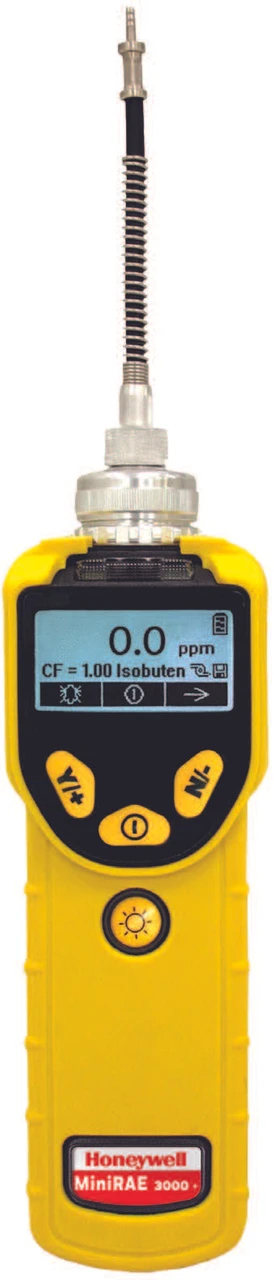
RAE Systems MiniRAE 3000+ PID VOC Gas Detector
RAE Systems
$4,146.51 - $4,693.86
- Weight:
- 6.50 LBS
- Shipping:
- Calculated at Checkout


RAE Systems MultiRAE Calibration Kit – 4-Gas & PID
$695.00 - $725.00

RAE Systems MiniRAE 3000+ PID – Portable VOC Gas Monitor
The RAE Systems MiniRAE 3000+ PID (Model PGM-7320) is a high-performance, handheld photoionization detector (PID) designed for detecting and measuring volatile organic compounds (VOCs) in industrial and hazardous environments. With a detection range of 0–15,000 ppm, a rapid 3-second response time, and wireless data transmission, the MiniRAE 3000+ provides reliable VOC monitoring for industrial hygiene, environmental testing, leak detection, and hazardous materials response.
Its advanced PID sensor features humidity compensation, built-in temperature and humidity sensors, and correction factors for more than 350 compounds. A built-in sampling pump, rugged IP67-rated housing, and interchangeable battery packs make this portable VOC detector suitable for demanding field applications.
Key Features and Benefits
- Wide VOC Detection Range: Measures VOC concentrations from 0 to 15,000 ppm.
- Fast Response: Provides a 3-second response time for rapid detection.
- Advanced PID Technology: Uses photoionization technology for monitoring volatile organic compounds.
- Wireless Connectivity: Built-in RF and Bluetooth capabilities support remote monitoring and data transmission.
- Humidity Compensation: Integrated temperature and humidity sensors help improve measurement performance.
- Built-In Sampling Pump: Draws samples from locations up to 100 feet (30 meters) away.
- Compound Correction Factors: Includes correction factors for more than 350 compounds.
- Rugged Construction: IP67-rated waterproof housing with a protective rubber boot.
- Data Logging: Stores up to six months of readings at one-minute intervals.
- Easy Maintenance: Provides tool-free access to the PID lamp and sensor.
Common Applications
The RAE Systems MiniRAE 3000+ PID is designed for professionals who need portable VOC detection in applications such as:
- Industrial hygiene and workplace exposure monitoring
- Hazardous materials (HazMat) response
- Chemical leak detection
- Environmental site assessments and remediation
- Industrial facilities and manufacturing plants
- Confined-space and hazardous-area monitoring
- Emergency response and environmental cleanup
Available MiniRAE 3000+ Purchase Options
Option 1 – Instrument with Leather Case and Accessories
- MiniRAE 3000+ PID monitor (PGM-7320)
- Travel download/charger
- Probe, filter, alkaline battery, lamp-cleaning and tool kit
- Soft leather carrying case
Option 2 – Instrument with Hard Case and Drop-In Charger
- MiniRAE 3000+ PID monitor (PGM-7320)
- Hard plastic carrying and storage case
- Drop-in charger assembly
- Probe, filter, alkaline battery, lamp-cleaning and tool kit
Option 3 – Instrument with Calibration Supplies, Hard Case and Drop-In Charger
- MiniRAE 3000+ PID monitor (PGM-7320)
- Calibration regulator and 100 ppm isobutylene calibration gas
- Hard plastic carrying and storage case
- Drop-in charger assembly
- Probe, filter, alkaline battery, lamp-cleaning and tool kit
Why Choose the RAE Systems MiniRAE 3000+?
The MiniRAE 3000+ combines advanced PID sensor technology, fast response, extensive VOC detection capabilities, and wireless monitoring in one portable instrument. Its rugged design and versatile accessories make it a valuable tool for industrial safety professionals, environmental consultants, emergency responders, and hazardous materials teams.
The MiniRAE 3000+ is the updated model replacing the MiniRAE 2000 and original MiniRAE 3000, with Bluetooth connectivity added.
Looking for a portable VOC gas monitor? Contact TG Technical Services for assistance selecting the RAE Systems MiniRAE 3000+ configuration and calibration supplies for your application.
Frequently Asked Questions About the RAE Systems MiniRAE 3000+ PID
What does the RAE Systems MiniRAE 3000+ detect?
The MiniRAE 3000+ is a portable photoionization detector (PID) designed to detect volatile organic compounds (VOCs). It measures VOC concentrations in parts per million (ppm) and can be configured with different UV lamp options depending on the chemicals being monitored.
What is the detection range of the MiniRAE 3000+?
With the standard 10.6 eV UV lamp, the MiniRAE 3000+ measures VOC concentrations from 0 to 15,000 ppm. Optional 9.8 eV and 11.7 eV lamps have different measurement ranges and chemical detection capabilities.
What is a PID gas detector?
A photoionization detector (PID) is an instrument that uses ultraviolet light to ionize certain gas and vapor molecules. The resulting electrical signal is measured to determine the concentration of detectable VOCs in the surrounding atmosphere.
PIDs are commonly used for industrial hygiene, environmental monitoring, chemical leak detection, and hazardous materials response.
What is the difference between a 10.6 eV and 9.8 eV PID lamp?
The difference is the ionization energy of the ultraviolet lamp. A 10.6 eV lamp detects a broad range of VOC compounds, while a 9.8 eV lamp can detect certain compounds that require a different measurement configuration. The appropriate lamp depends on the target chemical's ionization potential and the manufacturer's detection specifications.
What is the purpose of VOC correction factors?
Correction factors allow the MiniRAE 3000+ to adjust its displayed readings for specific VOC compounds when the instrument is calibrated using a reference gas, typically isobutylene.
This allows users to obtain more representative concentration readings for selected chemicals rather than relying solely on an isobutylene-equivalent measurement.
The instrument includes correction factors for more than 200 VOC compounds.
How often should the RAE Systems MiniRAE 3000+ be calibrated?
Honeywell recommends checking the monitor's accuracy by exposing it to known calibration gas before each day's use. The detector should be calibrated whenever it fails a bump test and at least every six months, depending on operating conditions, usage, and exposure to contaminants.
Always follow the manufacturer's current instructions and applicable workplace requirements.
How often should the MiniRAE 3000+ be bump tested?
The MiniRAE 3000+ should be bump tested before each day's use. A bump test exposes the PID sensor to a known concentration of test gas to verify that it responds appropriately.
Honeywell also recommends bump testing after physical impact, liquid immersion, an over-limit alarm event, changes in custody, or whenever instrument performance is in doubt.
What calibration gas is used for the MiniRAE 3000+?
The standard calibration reference gas is 100 ppm isobutylene. The calibration package option on this product includes a 34-liter isobutylene cylinder, calibration regulator, and flow controller.
How long does the MiniRAE 3000+ battery last?
The rechargeable lithium-ion battery provides up to 16 hours of continuous operation in non-wireless operation. Actual operating time depends on communication settings, battery condition, and operating conditions.
An alkaline battery adapter is included
Can the MiniRAE 3000+ monitor VOCs remotely?
Yes. The MiniRAE 3000+ supports wireless communication through compatible RF, Bluetooth, or Bluetooth Low Energy configurations. Optional communication accessories can extend monitoring capabilities and allow readings to be transmitted to compatible remote monitoring systems.
Can the MiniRAE 3000+ detect benzene?
The standard 10.6 eV lamp can detect benzene, but it does not provide the same compound-specific selectivity as a dedicated benzene measurement configuration. For applications requiring selective benzene monitoring, a suitable instrument configuration and measurement method should be selected.
Is the MiniRAE 3000+ intrinsically safe?
Yes. The instrument has hazardous-location certifications for specified configurations, including Class I, Division 1, Groups A, B, C, and D in the United States and Canada. Always verify the applicable certification, battery configuration, and approved accessories before use in hazardous locations.
Is the MiniRAE 3000+ waterproof?
The instrument has an IP67 rating when powered off and without the flexible probe installed. During operation, its protection rating is IP65. This provides protection against dust and water exposure under the specified test conditions.
What is the difference between the MiniRAE 3000 and MiniRAE 3000+?
The MiniRAE 3000+ is the updated version of the MiniRAE 3000. The updated model offers enhanced communication options, including Bluetooth connectivity, depending on configuration. Both instruments are designed for portable VOC monitoring using PID technology.
What industries use the RAE Systems MiniRAE 3000+?
Common applications include industrial hygiene, environmental remediation, oil and gas operations, chemical manufacturing, HazMat response, indoor air quality investigations, and industrial leak detection.
Where can I purchase the RAE Systems MiniRAE 3000+?
TG Technical Services offers the RAE Systems MiniRAE 3000+ portable PID VOC detector with multiple package options, including carrying cases, charging accessories, and calibration supplies.